At the end of last week’s parsha, the Torah shifts into what appears to be a long genealogical list—Esav’s wives and children, the clans of Seir, the kings of Edom. But names matter in Torah. They remind us that who we are is shaped by who came before us, and that mesorah is built step by step, generation by generation.
Pirkei Avot begins with the same reminder: “Moshe received the Torah from Sinai and transmitted it…” And our chain is not only textual. It includes the inherited ways of seeing and doing, lessons in the rich rewards of simply paying attention.
My grandmother a transmitter. The daughter and wife of farmers, she lived a life tied tightly to the land and its cycles. When we walked together in West Texas—a place whose heat and dryness are more like my new home in Beit Shemesh than Cleveland—she would point out every plant along the roadside. Mesquite, devil’s pincushion, Indian paintbrush; with each name came a story. The tornado that twisted the tree outside her kitchen window, which cousin once stepped on a cactus barefoot, what bloomed early, and what lasted late. She didn’t just identify plants; she preserved our family lore.
I didn’t realize it then, but she was teaching me mesorah. Not the kind you find in seforim, but the kind that shapes your eyes. The kind that teaches you to notice what grows, what thrives, what returns.
Here in Israel, I’m learning gardening all over again. The plants are different, the watering schedule more frequent. The growing season doesn’t fit into midwestern spring, summer, and fall. My garden in Cleveland is asleep under the snow as the weeds here are going crazy here as the rain starts to fall. This is work of a Jew: to learn and to keep learning. To be humbled by the world HaShem creates for us.
One of the most useful plant-related skills I’ve picked up came from another woman willing to share what she knew: a florist in Cleveland who taught me how to make Shabbat flowers last far longer than I imagined possible. In a culture fine-tuned for disposability, preserving beauty from week to week is radical.

The first step is to strip all the leaves. Leaves draw energy and moisture away from the blooms; removing them keeps the flowers’ strength where it belongs. Then trim the stems before placing them in water.
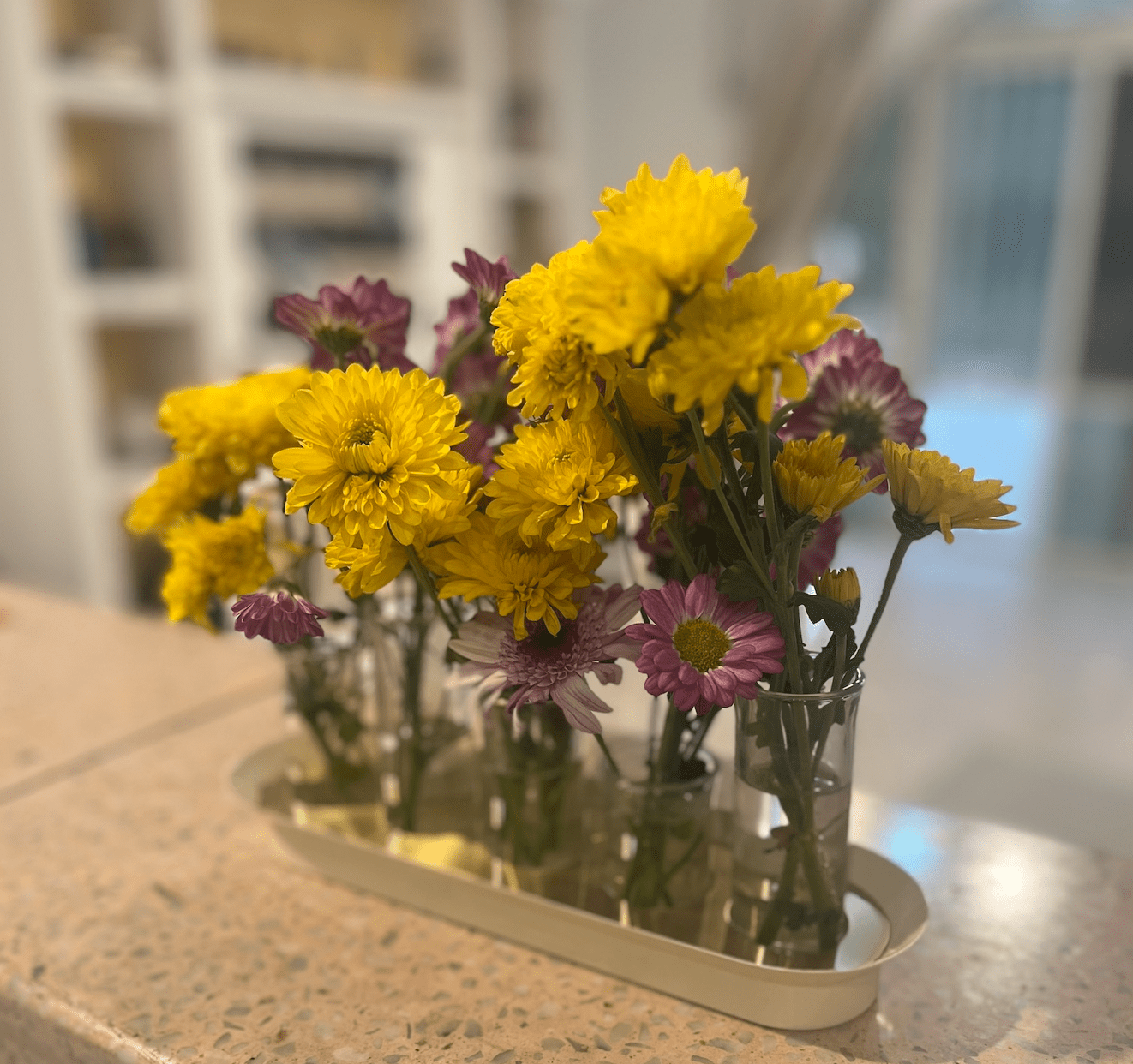
The following Thursday or Friday give the bouquet another look. Remove anything that looks tired, trim the stems down further, and refresh the water. Often this means moving the flowers to a smaller vase. My favorite is a little bud-vase set I got at from IKEA, which turns a handful of lingering stems into something airy and lovely for the Shabbat table. I also use small bottles that came in mishloach manot or once held makeup to spread buds around the house.
It’s such a small act, but every time I create a vase out of something that is often treated as garbage or enjoy a second or even third week from 20 shekel worth of flowers, I think of my grandmother walking a fenceline in the Texas heat, naming the world as she went. She taught me that tending what we already have is a form of gratitude. And maybe that is its own kind of mesorah—a way of honoring HaShem’s gifts by refusing to rush past them.
~Amy
Chanuka Chanukah Chanukka Chanukkah disinfect donuts doughnuts ecofriendly elul flowers food waste frum garden gardening gratitude Hannukah Hanukka Hanukkah homemaking israel jewish lag b'omer landfill lashon hara low-waste mishloach manos mishloach manot nature orthodox passover pesach plants purim recycle recycling reduce reusable reuse teshuva upcycling washcloth water conservation water waste zero-waste zero waste
 The Bal Tashchit Balabusta
Leave a comment