
At the heart of Chanukah is a deceptively simple moment: the decision to light with what was available. Not enough oil. Just one day’s worth. No backup plan. The miracle didn’t start when the oil lasted more than one night. It started when someone stopped waiting for better conditions and used what was at hand to make a defiled space holy.

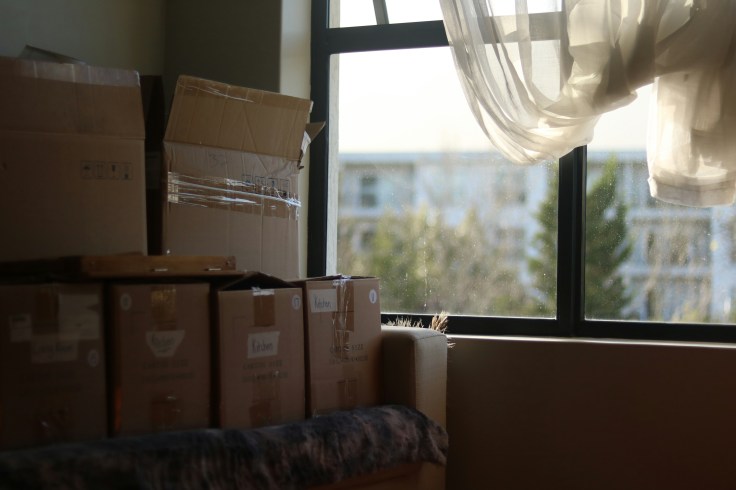
I’ve been thinking about that a lot as our lift finally arrived this week, because for months we’ve been living in what I can only describe as a-bird-in-the-hand mode. Not as a philosophy. As a necessity.
Back in June, when my husband got permission to keep his job while working from Israel, I went into immediate triage mode. Every day after work, I was packing, purging, or holding two objects and asking myself which one I could live without for three months. Eventually, the answer was: surprisingly many of them. Bags and piles waiting for pickup became a regular feature by my door. We held a two-day yard sale that turned into an impromptu goodbye party as friends and neighbors drifted through.
By the time my son and I arrived in Israel, almost everything we owned was floating somewhere on the Atlantic. We moved into our rental in October and promptly began camping inside a house. We slept on Ikea chair-beds. The living room was a sukkah cushion (quickly renamed “the crouch”), a desk, and a plastic garden chair. The kitchen was radically minimalist. We relied more than I’d like on disposables, and there was no such thing as leaving dishes in the sink. With a couple of spoons and a fork, everything got used at every meal.
In our old house in Cleveland, my husband had a sign in his music space that said, “It could be anything.” I’d seen it for years. In Israel, it stopped being a creative slogan and became instructions.
Low-waste living had already trained me to see possibilities where others see trash. But living with almost nothing sharpened that instinct into something else. Not it could be anything, but everything is something.
A hanging pot I bought secondhand to grow a cutting from a friend’s neighbor had a drainage hole so large that soil escaped every time I watered. The fix was a metal bottle cap with three holes punched through it—instant filter. The pigeon poop coating the mirpeset (balcony) didn’t yield to cleaning products I didn’t own, but to pieces of cardboard boxes from purchases we had lugged home on the bus (baruch Hashem for granny carts). A scrap of ribbon from a flower arrangement was used to tie a sprawling geranium upright against the fence. An old laundry basket became our trash can. Plastic shelves and a left-behind bookcase held my son’s clothes.
Was it elegant? No. Did it work? Every single time.
Chanukah reminds us that holiness doesn’t wait for ideal circumstances. It happens when we stop postponing and start lighting. Right now.
Our lift has arrived. I am deeply grateful for a couch that is actually a couch, for drawers full of cutlery, for a bed that does not fold. But the memory of moving before everything was in place and the habit of using what’s at hand—those are staying. Because the miracle didn’t come from having everything. It came from being willing to begin.
~Amy
Image of boxes by Alicia Christin Gerald via Unsplash
Chanuka Chanukah Chanukka Chanukkah disinfect donuts doughnuts ecofriendly elul flowers food waste frum garden gardening gratitude Hannukah Hanukka Hanukkah homemaking israel jewish lag b'omer landfill lashon hara low-waste mishloach manos mishloach manot nature orthodox passover pesach plants purim recycle recycling reduce reusable reuse teshuva upcycling washcloth water conservation water waste zero-waste zero waste
 The Bal Tashchit Balabusta
Leave a comment