
I didn’t think of myself as a water-waster before we made aliyah. We had rain barrels. I hung some laundry to dry. Some of us tried to remember to turn off the tap while scrubbing a pot or brushing our teeth. But here, water counts and is counted, is prayed for and anticipated. While the rooftop water tank supplies endless hot water on sunny days, the dood chasmal, the electric water heater, needs to be turned on about 10 to 12 minutes before a shower on cooler, cloudier days. On Fridays, water has to be managed deliberately so that everyone can shower in hot water before Shabbat but not get scalded when someone turns on the kitchen sink. Enough hot water doesn’t happen by accident.
It changes how you think.
When I first wrote about Israel’s water systems almost a decade ago, one statistic stopped me cold: Israel treated and reused roughly 85 percent of its wastewater, mostly for agriculture, while the United States reused only about 10 percent. Nearly ten years later, the gap remains stark. Israel now reuses close to 90 percent of its wastewater; the U.S. still hovers in the low teens, depending on the source and the state. (Israel also leads the world in minimizing water loss from aging infrastructure and in producing fresh water through desalination plants.)
In Cleveland, we had already instituted a practice of using the Echo smart devices in the bathrooms as shower timers. More than one Smith can lose track of time in there, so we capped those watery ablutions at seven minutes, which seems like a ridiculously long time to some of us and not nearly enough to others. Depending on the showerhead, that’s anywhere from 1.5 to 5 gallons per minute. “Do the math and it’s suddenly very clear how fast. “Just a few extra minutes” times five people adds up quickly.
The garden here has also forced a recalibration. Our old house had two rain barrels and rain fell throughout much of the growing season. This one has one, and water won’t fall for months at a time. The trees in the beds have their own irrigation system, so the barrel is used only for potted plants and one freestanding tree just outside the beds. When we moved in during October, all I was growing were two pots of basil, a pot of mint, and one ornamental I was trying to bring back from a near-death experience after the house stood empty over the fall chagim.
By December, the rain barrel was empty anyway.
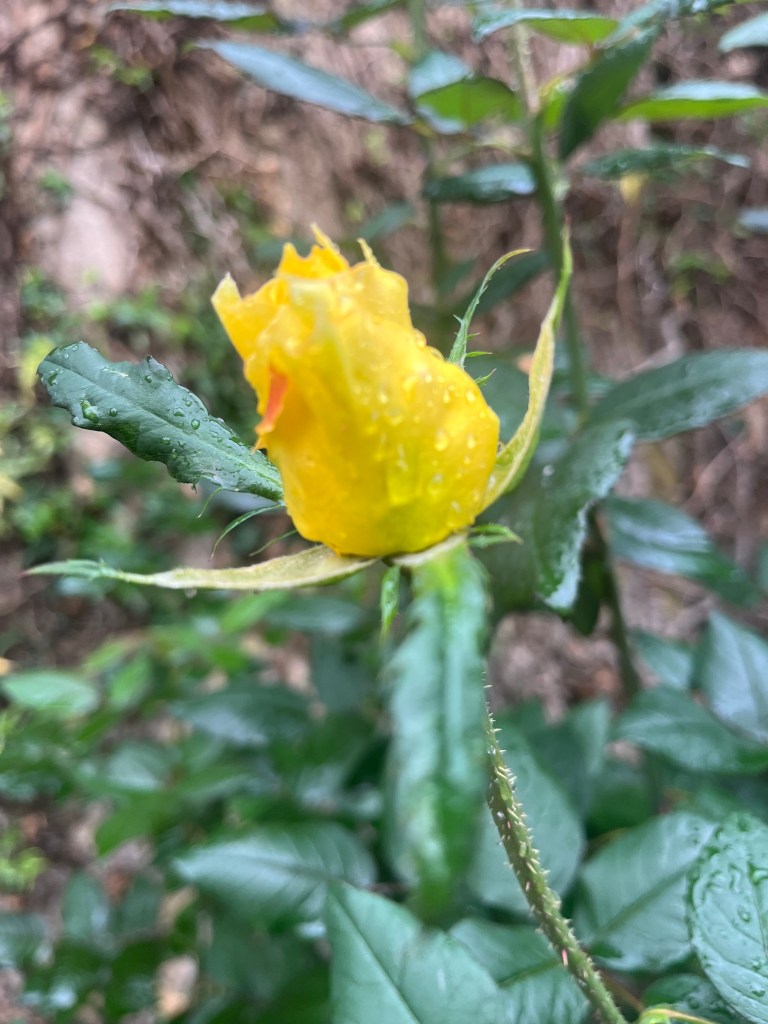
What’s startling is how much is growing on our small lot. I can see into my neighbor’s window. I can hear the scrape of chairs from the house we share a wall with. And on this modest lot we have trees—a fig tree, olive, pomegranate, clementine, pomelo, plum, avocado, and lemon—along with two palm trees, a rose bush, a giant geranium, and assorted succulents. This density is the quiet miracle of drip irrigation, a system that delivers water directly to a plant’s roots in slow, precise amounts.
Its origin story is almost folkloric: in the 1950s, engineer Simcha Blass noticed that one tree along a fence line was thriving while the others struggled. A tiny leak in a pipe nearby was feeding it steadily, drop by drop. From that observation came a technology that would reshape agriculture in arid climates around the world.
Right now, we’re in the rainy season. And when it rains, it really rains. Enough that there’s a sometimes water coming up over the threshold into the lower level of the house. (A handyman is coming next week to help us deal with that.) It’s not really a basement—just lower than the kitchen and dining room, with a door that opens to the paved back garden and a full-sized window that lets in plenty of light. Still, water, and gravity, have a way of asserting themselves.
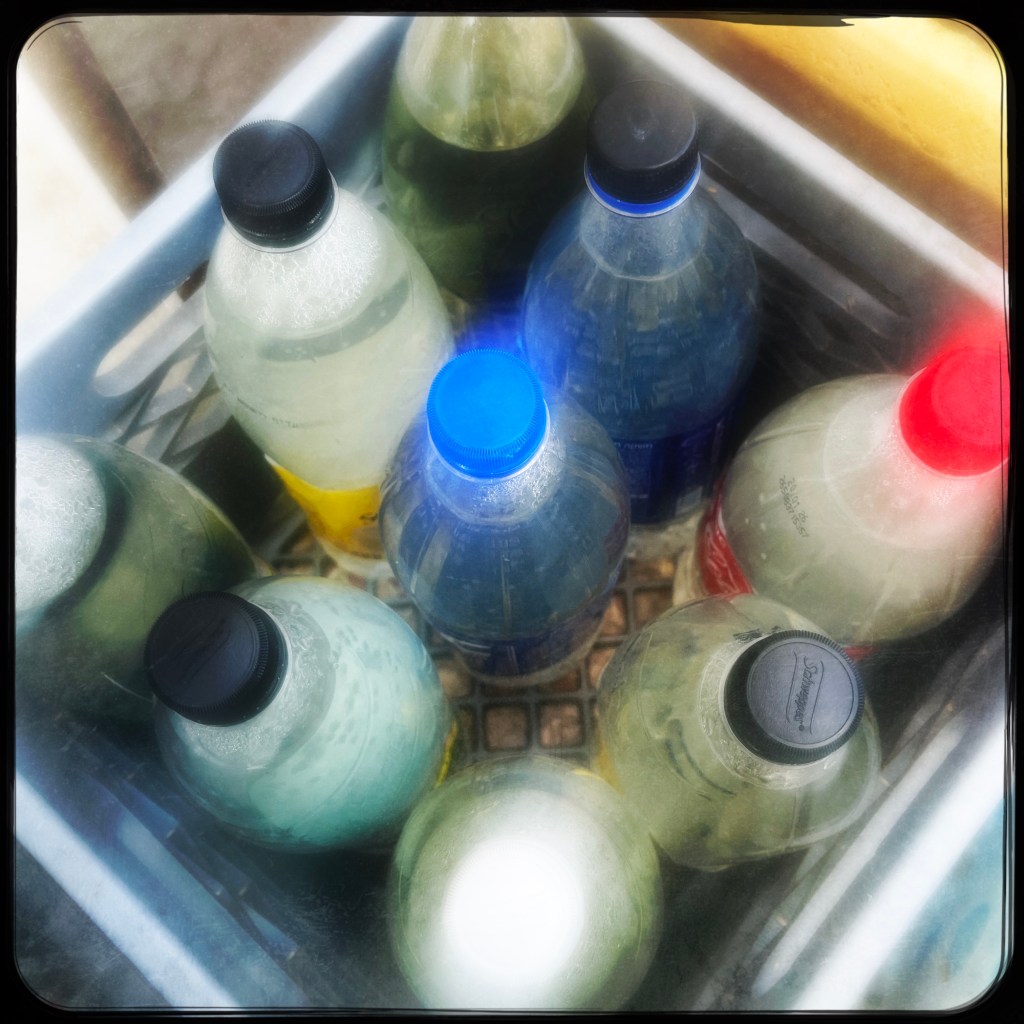
We try to avoid single-use plastic, but we do buy soda for Shabbat and bitter lemon and tonic water for mixes. When they’re empty, I’m filling them with water from the rainbarrel so it can catch some more in the next storm. I already have more 20 liters stored since the rains started in earnest last month. As I’m writing this, I’m realizing there’s no reason not to use wine bottles to store water; they come with a cork, after all. I’m realistic: my small rain barrel in Cleveland dried up every summer, and these bottles won’t carry me through the longer dry season here. But they will get me further into spring. More of today’s rain will show up later, when it matters more.
I’m also hoping that as I add planters to the back garden—on a slope that currently sends rain straight toward the house—more water will be absorbed into soil and roots instead of racing downhill. Slowing water down is conservation, too.
Some of what I’m doing is just standard arid-climate practice:
- Watering at the base of plants, so moisture goes to the roots instead of evaporating.
- Mulching to keep soil cool and reduce water loss.
- Choosing plants carefully. I’m already growing basil and mint, and I’ll add more herbs and flowers that don’t need a lot of water to bloom. Tomatoes are still undecided. I love growing my own, but they’re big drinkers, and I’m not convinced they belong outside a greenhouse here.
An unexpected water choice I made since aliyah was suggested by the house itself. Our laundry room is also our miklat, the reinforced safe room that’s mandatory in Israeli homes. The previous tenants had jerry-rigged a solution that let them vent the dryer out the window. I didn’t love the idea of someone having to run outside and close the blast shield during a siren, and the cardboard and duct tape solution disturbed my aesthetic sense. So we bought a condenser dryer. Instead of venting moisture into the air as steam, it collects the water in a removable tank that has to be emptied.
That water will go straight to the garden during the hot months.
Most laundry—everything except towels—is hung on a rack to dry anyway. That’s normal here. But even when I use the dryer, the water won’t disappear into thin air.
All the bottles and mulch on the planet won’t solve water scarcity. But my little efforts will make a difference. And they also remind me that abundance is often temporary, that some blessings change with the seasons, and that it’s important to savor every drop of goodness that flows my way.
Rain is not something we can take credit for. We can build systems, pipes, barrels, and bottles—but rain itself comes only from HaShem’s hand. Unlike other externalities, we can’t convince ourselves that it’s the work of ours. We can only decide what kind of vessels we’ll be when it arrives.
~Amy
Chanuka Chanukah Chanukka Chanukkah disinfect donuts doughnuts ecofriendly elul flowers food waste frum garden gardening gratitude Hannukah Hanukka Hanukkah homemaking israel jewish lag b'omer landfill lashon hara low-waste mishloach manos mishloach manot nature orthodox passover pesach plants purim recycle recycling reduce reusable reuse teshuva upcycling washcloth water conservation water waste zero-waste zero waste
 The Bal Tashchit Balabusta
Leave a comment