
It’s rough being a Jewish gardener. If you want spring planting season not to overlap with Pesach prep, you basically need to relocate to northern Canada or somewhere in the Southern Hemisphere. Everywhere else, there is a good chance you will find yourself pulling weeds while mentally reviewing whether you checked all your coat pockets and bags for chametz.
This year, gardening season arrived alongside missile alerts.
Middle-of-the-night prealerts are obviously the worst. But prealerts while weeding around a crown-of-thorns bush, announced by a jangly sound from the Homefront Command app, have to rank close behind. I managed to get this this particular combination twice. Both times, the alert startled me badly enough that I jerked backward into the thorns and scratched up my hands and arms. Another alert found me on a ladladder pruning the fig tree; luckily I didn’t fall. My rotten luck!
There have not been sirens for a few weeks now, but I still half expect one every time I weed around those bushes. The association has settled into my nervous system.
I’m also having rotten luck, but in a good way. Back in Ohio, I had a double tumbling composter we bought new plus an old rolling trash can with drainage holes drilled into the bottom. (The trash can worked better.)
I tried building a new setup here out of two large plastic bins that had lost their lids, but in a tiny Israeli garden it was giving less “committed environmentalist” and more “crazy lady starting a junkyard.” Eventually I bought a composting bag about the size of an outdoor trash can. It’s made from the same heavy material as a plastic tarp and has a little hatch at the bottom to access finished compost.
I’m afraid my compost turner will poke a hole in it, so instead I roll the entire thing back and forth across the fake grass while singing the theme song to Oklahoma!
I got started composting late in my gardening life, mostly because books about composting made it sound much harder than it is and most include math.
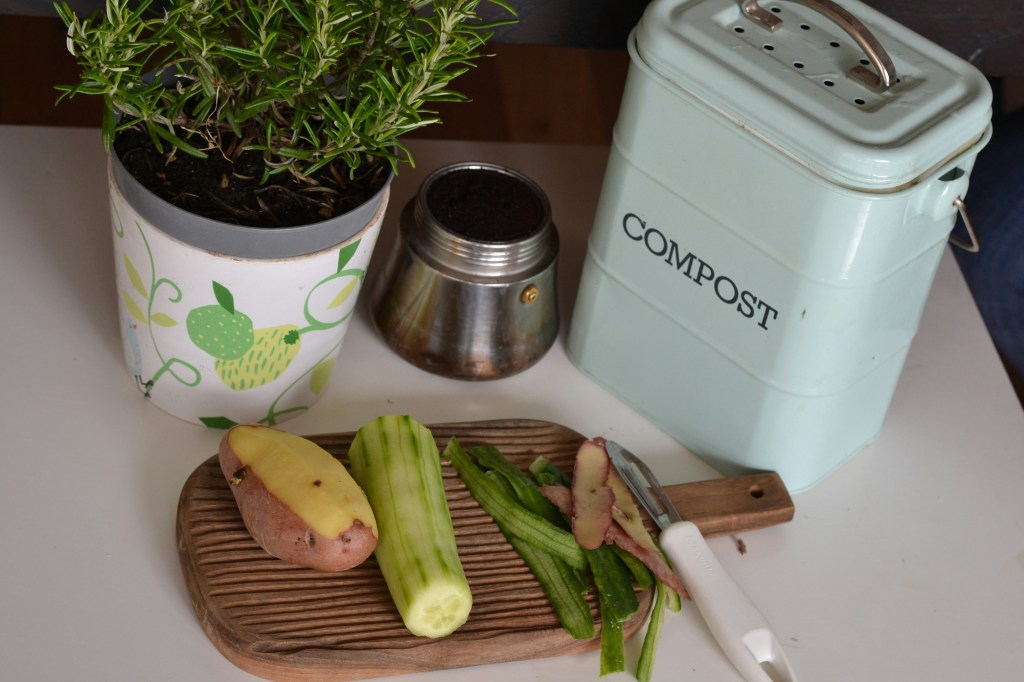
Here’s what I’ve learned: you need a container that will hold heat and moisture; “browns” like dried leaves, cardboard, or paper; and “greens” like vegetable scraps, coffee grounds, expired produce, and the bits trimmed off while cooking. No meat, dairy, or citrus. Add water often enough to keep it damp. Turn it occasionally. Or don’t. Nature is surprisingly willing to do most of the work.Compost should have a slightly earthy smell. If it smells bad, you probably need more of whatever category you have less of. That’s it. And I’m not even trying to sell you a book.
I never really tire of the fact that HaShem built a world where the leftover bits become new life. “Garbage” turns back into soil. Dead leaves and coffee grounds and carrot peels become tomatoes.
Maybe that’s part of what it means to live in the old-new land: fig trees and missile alerts, carrot peels fueling tomatoes, ordinary chores unfolding inside history. Judaism has always sanctified the ordinary — food, time, seasons, the slow counting of days during the Omer while the barley ripens in the fields. Even now, with our apps and alerts and fake grass, I am still trying to learn the same ancient lesson: nothing in creation is too small to matter.
~Amy
Photo by Lenka Dzurendova on Unsplash
Chanuka Chanukah Chanukka Chanukkah disinfect donuts doughnuts ecofriendly elul flowers food waste frum garden gardening gratitude Hannukah Hanukka Hanukkah homemaking israel jewish lag b'omer landfill lashon hara low-waste mishloach manos mishloach manot nature orthodox passover pesach plants purim recycle recycling reduce reusable reuse teshuva upcycling washcloth water conservation water waste zero-waste zero waste


Leave a Reply